

Casino loyalty tiers work best when status feels clear, valuable and visible. Learn how to structure tiers, thresholds, benefits and casino cards.
You have a tier system. Players earn points, move up a level, and technically unlock better perks. However, your floor staff still can’t tell a Gold member from a Silver one without checking the system, and your top-tier players don’t act like they know they’re top-tier.
The status exists on paper. It doesn’t exist in the room.
If that sounds familiar, the problem usually isn’t the rewards behind your tiers. It’s the structure carrying them.
Casino loyalty tiers – in short
- A tier system only creates real status if it’s visible on the floor, not just in the backend — that’s usually the actual gap, not the rewards.
- Tiers should combine spend with visit frequency, so consistent players outrank one-time big spenders.
- Three to four tiers works better than six — research shows adding tiers at the bottom boosts perceived status more than splitting the top tier further.
- The physical card is still the fastest way a player’s status becomes visible — a different material or finish per tier does more than extra points.
- Most programs plan for climbing but not for dropping a tier — clear requalification rules and advance notice keep a downgrade from feeling like a punishment.
Points or Visits: What Should Actually Move a Player Up a Tier?
Most operators frame this as a choice: reward spend, or reward engagement. Pick one, build the math around it.
That’s the wrong question.
The programs that create real aspiration reward both — spend determines the pace of advancement, but visit frequency and consistency protect it.
A player who wagers heavily in one visit and disappears for three months shouldn’t outrank a player who shows up every week and plays steadily. One is a transaction. The other is a relationship, and tier status is supposed to recognize the relationship, not the receipt.
In practice, this means your tier formula should combine a spend or theoretical-win metric with an activity component — visits per period, or a minimum number of qualifying sessions.
Spend alone rewards whales. Spend plus consistency rewards the players who actually build your baseline revenue.
A Three-Question Check: Is Your Tier System Actually Working?
Before touching the structure, run these checks.
Check 1 — The floor test. A Platinum member walks up to a table. Can your dealer or host recognize their status in under three seconds, without looking anything up? If the answer depends on a screen, the tier isn’t visible — it’s buried.
Check 2 — The gap test. Pull your tier distribution. Is there a tier that almost nobody reaches, and one that almost everybody sits in by default? A pyramid with no shape isn’t creating aspiration; it’s just a label.
Check 3 — The exit interview test. When a player drops a tier, do they know why, and do they know what it takes to get it back? If the answer is “they probably got an email,” your requalification process is invisible too — and invisible loss doesn’t motivate anyone to come back.
If any of these expose a gap, the fix usually isn’t more rewards. It’s structure.
How Many Tiers Should You Actually Run?
Three to four tiers is the range most land-based programs settle into, and there’s a real reason it holds up rather than being an arbitrary industry habit.
Research on loyalty program structure published in the Journal of Consumer Research (Drèze & Nunes, 2009) found something counterintuitive: adding more members to a top tier actually dilutes how special that status feels, while adding a lower, subordinate tier underneath the entry level increases perceived status at the tiers above it. In plain terms — a program feels more prestigious when there’s visibly more room below you than when there’s more competition beside you.
For a casino floor, that translates into a practical rule: don’t add tiers at the top to chase more granularity among your best players. Add structure at the bottom instead, so your mid-tier players have something clearly beneath them.
A four-tier system — entry, mid, upper, elite — usually does more for perceived status than a six-tier system that just slices the same player base into thinner bands.
What a tier structure won’t fix on its own: if the benefits and comps behind each tier are weak, forgettable, or copy what every competitor already offers, no amount of structural psychology will make players chase them. Tier design creates the ladder. It doesn’t create a reason to climb it — the rewards program still has to do that part.
The Card Is Where the Status Actually Lands
Here’s where most operators lose the plot. They design a solid tier logic — thresholds, benefits, requalification rules — and then hand every tier the same generic card, differentiated only by a name printed on it.
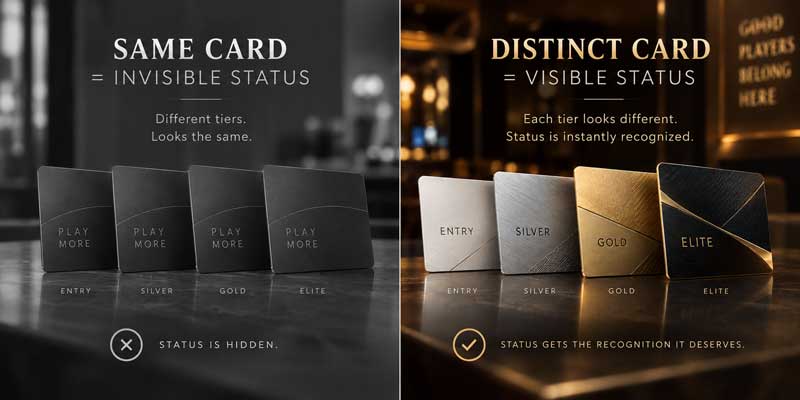
That’s a missed signal, because the physical membership card is still the first thing that tells a player, and everyone around them, what tier they’re in. A player doesn’t read their tier status off a dashboard. They feel it the moment they pull a card out of their wallet at the cage, and so does the guest standing next to them. A meaningfully different material, finish, or color at each tier does more to make status feel earned than another 500 bonus points ever will — because it’s visible in a way a points balance isn’t.
This is also where the “endowed” effect from tier design actually gets reinforced physically, not just numerically: a player holding a card that looks and feels different has tangible proof of where they stand, not just a number they have to log in to check.
If you want your tier structure to feel just as distinct in a player’s hand as it does in your loyalty system, contact Cards Print to create casino cards designed around each level of status.
How to design the Tier Ladder? A Practical Sequence
- Set your entry tier at genuinely low friction. If it takes meaningful spend to even get a card, you’ve built a VIP program with an extra step, not a tier system. Entry should be nearly automatic — the aspiration starts one level up.
- Set thresholds against your actual player data, not a competitor’s published numbers. Pull your play data and find the natural break points where activity clusters. Thresholds copied from a competitor’s program rarely match your player base’s real spend distribution.
- Make the benefit jump between tiers noticeable, not incremental. A 2% increase in point multiplier from one tier to the next won’t move anyone. A materially faster cashout, a dedicated host, or access nobody below that tier gets will.
- Give each tier a distinct card, not just a distinct name. This is the step most programs skip, and it’s the one players notice the fastest.
- Publish the requalification rule clearly, in one sentence a player could repeat back to you. If your own staff can’t explain how to keep a tier in one sentence, players definitely can’t.
The Case Operators Get Stuck On: What Happens When a Player Drops a Tier?
This is where most tier programs quietly fail, because most of the planning goes into climbing, not falling.
A player reaches Gold, plays consistently for six months, then has a slow quarter — travel, budget, life. Requalification time comes, and they drop to Silver with no warning, a generic email, and a new card waiting at the desk that looks identical to the one a first-time member gets.
That player doesn’t feel motivated to climb back. They feel quietly punished, and the drop reads as the casino taking something away rather than the player having to earn it back.
The programs that handle this well do three things: they give advance notice before a requalification deadline, not after it’s missed; they offer a clear, specific path back (“X more visits this quarter restores Gold”) instead of a vague “keep playing”; and they don’t reissue a downgraded card as a blank slate — a player who’s been Gold for two years isn’t the same as a brand-new Silver member, and treating the card design that way erases history the player remembers.
Handled this way, a tier drop becomes a temporary setback with a visible way back. Handled poorly, it’s the moment a loyal player quietly starts comparing your floor to the casino down the road.
FAQ about casino loyalty tiers
1. How often should casino loyalty tier thresholds be reviewed?
Tier thresholds should be reviewed at least once a year, or sooner if player behavior changes significantly. The goal is to make sure each tier still represents a meaningful difference in value and that too many players are not clustering in one level.
2. Should VIP players have a separate tier or a separate program?
It depends on how different their treatment really is. If VIP players receive substantially different service, benefits, access, and communication, a separate VIP structure can make sense. If the difference is mainly a higher reward multiplier, keeping them as the top tier of the same program is usually simpler.
3. Can players move up a tier instantly, or should upgrades happen periodically?
Instant upgrades usually create a stronger sense of progress because the player sees the reward as soon as the threshold is reached. Delayed upgrades can weaken that connection, especially if the player has to wait until the end of a month or quarter to receive the new status.
4. Should loyalty tier benefits be the same for every casino location?
Not necessarily. Multi-location operators can keep the core tier structure consistent while adapting some benefits to each property. What matters is that players still understand what their status means across the entire brand.
5. How do you know when a loyalty tier is too easy to reach?
A tier may be too easy to reach when a large share of active players qualifies for it and the status stops feeling selective. Operators should look at the percentage of players in each tier, not just the number of people moving upward. A premium tier should remain attainable, but it should still signal a meaningful level of loyalty.
A tier system earns its name when a player can look at their card, know exactly where they stand, and know exactly what it takes to move up — without opening an app or asking a host. That takes structure most operators skip: fewer, more meaningfully spaced tiers; thresholds built on real data; benefit jumps players actually notice; and a card that changes with the tier, not just a label that does.
Get the structure right, and the tiers stop being a backend rule set. They become the reason a player plans their next visit around getting back what they had — or reaching what’s next.
If your current tier structure feels flat, or your cards don’t visibly separate your top players from everyone else, get in touch — we work with casino operators on exactly this: card programs built to make status feel real the moment a player pulls the card out of their wallet.