

Casino rewards cards power modern casino systems. Discover how operators turn tracking data into measurable revenue growth.
Casino rewards cards have evolved far beyond simple point-collection tools. What once functioned as a basic incentive mechanism has become a core data infrastructure layer inside modern casino operations. Today’s rewards card systems connect player identification, behavioral tracking, and real-time incentives into a single commercial engine designed to increase visit frequency, optimize spend per session, and extend player lifetime value.
While casino loyalty cards often describe the broader membership framework -tiers, benefits, and branding – the rewards card itself is the operational backbone: the instrument that captures play data, activates offers, and links physical gaming floors to digital platforms.
Modern casino groups now rely on rewards cards to power cashless play adoption, unify CRM profiles across touchpoints, and orchestrate omnichannel marketing campaigns that span gaming devices, mobile apps, hotel systems, restaurants, and kiosks.
In increasingly competitive markets, where acquisition costs rise and retention determines long-term profitability, rewards cards are no longer optional infrastructure—they are strategic profit-optimization tools embedded into daily operations.
What Is a Casino Rewards Card?
A casino rewards card is a physical or digital identifier issued to players that enables casinos to track gaming activity, assign value to play, and deliver personalized incentives in real time.
From an operator’s perspective, the rewards card functions as the transactional and analytical layer of a broader player engagement ecosystem—capturing behavioral data, triggering offers, and linking every visit to a unified customer profile.
Rewards cards are designed specifically for operational integration. They connect directly to slot management systems, table-game rating platforms, cashless wallets, POS terminals, and marketing engines, turning raw play data into actionable revenue strategies.
Physical vs Digital Rewards Cards
Traditional rewards cards are physical plastic cards issued at enrollment desks or kiosks and used throughout the property for identification and redemption. These cards often contain embedded technologies such as magnetic stripes, NFC chips, or RFID that allow instant authentication at gaming devices, kiosks, hotel desks, and restaurants.
Digital rewards cards extend the same functionality into mobile environments. Stored inside casino apps or digital wallets, they enable touchless identification, QR scanning, and seamless integration with cashless play solutions—reducing friction while expanding data capture across channels.
NFC, RFID, and QR-Based Systems
Modern casino rewards card programs typically rely on multiple identification technologies:
- NFC and RFID chips enable proximity-based recognition at machines, tables, and access points, supporting fast authentication and secure cashless transactions.
- QR-based systems use dynamically generated codes displayed on mobile devices or printed cards, allowing flexible scanning at kiosks, POS terminals, or promotional checkpoints.
- Mobile wallet integrations embed the rewards credential directly into smartphones, enabling biometric authentication and real-time balance updates while lowering card-replacement costs.
Operators increasingly deploy hybrid environments in which physical cards, mobile credentials, and QR codes coexist—ensuring coverage across demographics and operational scenarios.
Rewards Card vs Loyalty Card vs Player Card vs Membership Card
These terms are often used interchangeably in marketing, but they serve different functional roles inside casino organizations:
- Rewards card refers to the operational tool that records play, calculates incentives, and activates promotions. It is the data-collection and monetization engine.
- Loyalty card typically describes the broader program layer—tier structures, branding, benefits, and long-term engagement strategy—of which the rewards card is a central component.
- Player card is commonly used in gaming operations to indicate an identification credential linked to wagering activity, often synonymous with rewards cards but sometimes limited to tracking rather than marketing automation.
- Membership card usually functions as a general access or enrollment credential, which may or may not include real-time rewards functionality.
How Casino Rewards Cards Work (Operator View)
From the outside, casino rewards cards appear simple: players insert a card, earn points, and redeem benefits. Behind the scenes, however, these systems operate as sophisticated data pipelines that connect gaming devices, service desks, analytics platforms, and marketing engines in real time.
For operators, rewards cards form the execution layer of loyalty strategy—capturing play behavior, standardizing identification across departments, and enabling automated decisioning that drives profitability at scale.
Player Identification Layer
The first function of any rewards card program is reliable player identification across every touchpoint on property. Each time a card is inserted, tapped, scanned, or authenticated through a mobile app, the system links activity to a single customer profile.
For casino groups operating across multiple properties, this identification layer is what allows play to follow the player—creating continuity across visits, venues, and channels.
Data Collection & Session Analytics
Once a player is authenticated, the rewards card becomes a data collection instrument. Every session generates granular metrics that feed analytics engines and revenue models.
These metrics allow operators to move from reactive promotions to predictive engagement, identifying high-value guests, flagging churn risk, and adjusting incentives dynamically rather than relying on static offers.
Reward Logic Engines
The final layer converts behavioral data into commercial outcomes. Reward logic engines determine how value is earned, when benefits are triggered, and which incentives are delivered to each segment.
For operators, this automation layer is where rewards cards transition from tracking tools into profit optimization systems—balancing reward costs against expected lift in spend, visit frequency, and lifetime value.
Are Casino Rewards Cards Worth It for Operators?
For casino operators, the business case for rewards cards is ultimately measured in economics: additional revenue, operational efficiency, and customer lifetime value. When properly designed, casino rewards card systems consistently outperform generic discount-driven promotions by tying incentives directly to measured play behavior rather than blanket offers.
ROI Models Used by Casino Groups
Operators typically evaluate rewards card programs using incremental ROI frameworks rather than gross revenue lift alone. Core variables include:
- Additional coin-in generated after campaign activation.
- Changes in theoretical win per visit compared to control groups.
- Increases in visitation frequency among enrolled players versus non-carded guests.
- Redemption rates and reward cost relative to theoretical win
- Marketing efficiency, measured through reduced reliance on mass promotions.
Lift in Visit Frequency and Spend
One of the most consistent outcomes of mature rewards card deployments is improved behavioral stability. Players who regularly use rewards cards tend to:
- return more often due to accumulated point balances and tier progress,
- increase average session value to reach thresholds faster,
- consolidate play within a single property group rather than splitting spend across competitors.
For operators in saturated markets, even modest percentage lifts in repeat visits can translate into significant gains at scale.
Managing the Cost of Rewards
Rewards cards do not create value in isolation—the economics depend on disciplined reward design. Successful programs anchor incentives to theoretical win, ensuring that:
- play that generates higher profit for the casino receives larger rewards,
- low-profit activity must not erode margins through excessive benefits,
- reward value is kept under control by limiting how quickly points can be earned.
Dynamic reward catalogs, blackout rules, and tier-based redemption limits help operators maintain balance between perceived generosity and financial sustainability.
Automation vs Manual Comping
Historically, many casinos relied on hosts and floor staff to manually issue comps (complimentary benefits for players) based on subjective judgment. Rewards card platforms replace much of this friction with automated decisioning:
- algorithmic comp thresholds,
- real-time triggers,
- standardized tier benefits,
- audit-ready reporting.
Automation improves consistency and regulatory transparency while freeing hosts to focus on relationship-building rather than calculations. Manual comping still plays a role for top-tier guests, but increasingly operates on top of data-driven baselines rather than intuition alone.
Rewards Cards as a Visible Brand Signal on the Gaming Floor
Casino operators rarely treat rewards cards as generic access credentials.
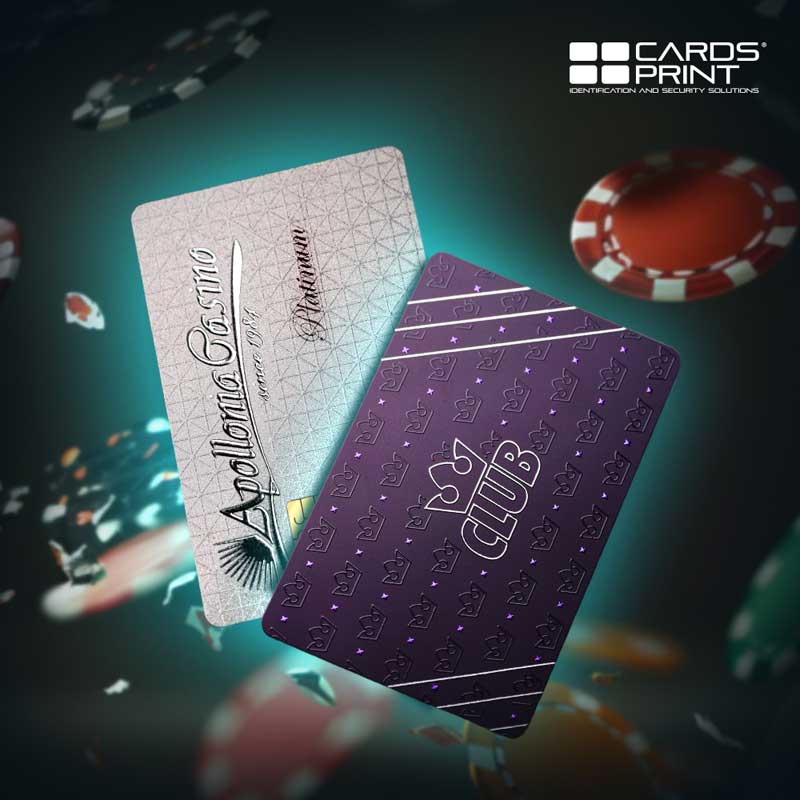
The physical card functions as a highly visible brand artifact on the gaming floor – communicating tier level, exclusivity, and property identity at a glance.
Color systems, effects on cards and finishes, typography, and materials are often aligned with interior design, VIP programs, and broader brand positioning, turning the card into a portable extension of the casino experience.
Beyond aesthetics, branded and quality casino cards serve operational and security purposes. Proprietary layouts, layered printing techniques, custom holographic elements, and embedded chip configurations make duplication significantly more difficult, protecting both player accounts and reward balances. In regulated environments, this physical differentiation also supports auditability and fraud prevention by making unauthorized cards easier for staff to detect.
For multi-property groups, card design becomes part of portfolio strategy. Operators may issue different visual identities for regional properties while preserving shared technical standards, or deploy tier-specific cards, such as metallic finishes for top segments,to reinforce status recognition and behavioral incentives.
Because of these combined commercial and compliance roles, many casinos work with specialized manufacturers such as Cards Print Casino Solutions, which focus on bespoke casino card production, secure encoding, and anti-counterfeiting technologies. This allows operators to tailor visual identity, embed security layers, and maintain consistent quality across large volumes—ensuring that rewards cards strengthen brand equity while protecting program integrity at scale.
Core Business Benefits of Casino Rewards Cards
For casino operators, casino card benefits extend far beyond promotions.
Integrated with gaming systems, CRM platforms, and cashless environments, these cards enable predictive revenue management—capturing data, triggering interventions, and scaling personalization across properties.
Advanced Player Segmentation
Rewards card data enables dynamic segmentation based on wagering patterns, visit frequency, preferences, and non-gaming spend—allowing operators to target high-value guests, upgrade mid-tier players, and identify churn risk early.
Churn Prediction and Retention
Continuous session tracking supports predictive models that surface disengagement signals before revenue declines. Automated win-back campaigns and tier-protection mechanics activate timely interventions.
VIP Identification
Real-time recalculation of player value helps teams prioritize outreach, personalize hospitality, and allocate premium experiences using objective performance criteria.
Marketing Automation
Rewards cards power omnichannel campaigns through CRM and campaign engines , triggering messages at kiosks, on devices, or via mobile channels while reducing manual workload.
Real-Time Incentives
In-session triggers such as bonus multipliers, dining credits, or targeted free play allow operators to influence behavior while players remain on property.
Cashless Enablement
By linking wallets and authentication to a single credential, rewards cards accelerate cashless adoption, reduce friction, and expand transactional visibility, further strengthening their commercial impact.
KPIs Casino Operators Should Track in Rewards Card Programs
Casino rewards cards generate large volumes of data, but value comes only when operators track the right performance indicators. Mature programs focus on a limited set of KPIs that directly connect engagement to profitability.
Key metrics include:
- Active card rate, measuring how many enrolled players actually use their rewards card during visits.
- Redemption rate, which helps balance perceived value against reward cost inflation.
- Theoretical win per visit, segmented by tier and campaign exposure.
- Tier migration velocity, showing how quickly players move up—or down—within the hierarchy.
- Churn risk indicators, based on declining frequency or shortened sessions.
- Campaign response rate, comparing triggered offers against control groups.
Tracking these indicators allows operators to continuously recalibrate earn rates, tier thresholds, and incentive timing without eroding margins.
The Future of Casino Rewards Cards
Emerging trends include:
- AI-driven personalization, where reward logic adapts dynamically to predicted behavior rather than static segments.
- Deeper cashless integration, positioning rewards cards as wallets rather than point trackers.
- Omnichannel identity, linking on-property play with online gaming, hospitality, and entertainment platforms.
FAQ — Questions About Casino Rewards Cards
Can casino rewards cards be issued to temporary visitors or tourists?
Yes. Many operators design fast-track enrollment workflows at kiosks or cages that allow short-stay guests to receive limited-scope rewards cards, capturing data without committing to full identity verification unless thresholds are reached.
Do casino rewards cards work for non-gaming spend?
Modern systems often extend beyond gaming activity, linking purchases at restaurants, hotels, retail shops, and entertainment venues to the same rewards profile—creating a unified view of total customer value.
Are rewards cards suitable for small or regional casinos?
Yes. Scalable architectures allow smaller properties to deploy streamlined programs focused on frequency and retention before expanding into enterprise-grade personalization and cross-property features.
Casino rewards cards are no longer peripheral loyalty tools. When engineered correctly, they form the connective tissue between gaming systems, customer data, and revenue optimization strategies.
Let’s build casino rewards cards that perform.
Contact us to discuss secure production, custom design, and all other card-related requirements.