

What is a casino comp program? It turns your tracked play into comp points, a comp balance and real perks — here’s how comps actually work and add up.
- What it is: A rewards system that gives players free perks based on how much and how long they play.
- How you earn: Every wager is tracked — usually through a player card — and turned into comp points.
- Comp points: The in-program currency you build up; earning rates vary by game.
- Comp balance: Your total redeemable points or comp dollars — often with an expiry date.
- How comps are set: By theoretical loss (ADT), not by whether you won or lost.
- Where it starts: One swipe of the player card. No card, no tracking, no comps.
Walk onto any casino floor and you’ll see people sliding a small plastic card into a slot machine before they spin. That card is the quiet engine behind a casino comp program, and most players have no idea how much it actually does.
If you’ve ever wondered why one player gets a free suite and another gets a coffee voucher, the answer isn’t luck. It’s data, and it starts the second that card is swiped.
What is a casino comp?
A casino comp is a complimentary item or service a casino gives a player to reward their play and encourage return visits.
The word is simply short for “complimentary.” Comps range from a free drink at the machine to meals, hotel rooms and show tickets, and, for the biggest players, flights and private suites.
One thing to fix in your head right away: the size of a comp tracks the value of your play, not the size of your win. The casino is rewarding how you bet, not how lucky you got.
What is a casino comp program?
A casino comp program is a structured rewards system that awards players perks based on how much, how often and what they play.
Every comp is calculated from tracked betting behavior using set formula, not handed out at random. Think frequent-flyer miles, built for the gaming floor.
The casino isn’t giving away free stuff out of goodwill – it’s reinvesting a slice of your expected value to keep you coming back. And to do that, it needs to know exactly who you are and how you play. That’s the whole reason the player card and tracking system exists in the first place.
What are comp points at a casino?
Comp points are the currency inside a casino comp program.
You earn them automatically as you wager – a common rate is one point per set amount bet, for example one point per $10. The more you play, the more you accumulate, and those points can later be redeemed for cash, free play or perks.
The earning rate isn’t the same everywhere. Slots usually earn points fastest because of their higher house edge; table games tend to earn slower. So two players spending the same money can build very different balances depending on what they play.
Now the part that connects everything.
In a land-based casino, none of this happens unless your play is attached to you. That attachment is the player card. Every swipe links your session — bet size, duration, game — to your account, and the RFID, NFC or MIFARE technology in the card is what makes that read instant and reliable.
What comp points won’t do, so you’re not surprised: they aren’t free money with no strings. They vary wildly by game, they usually expire after a stretch of inactivity, and – this one trips everyone up – they’re often not the same thing as the points that move you up tiers.
What is comp balance at a casino?
Your comp balance is the total of comp points (or comp dollars) you’ve accumulated and haven’t spent yet.
It’s what you have available to redeem — for free play, cashback, dining, rooms or merchandise. Redemption rates and minimums vary from one property to the next.
That balance usually has a clock on it. Many programs reduce or wipe points after 90 days to a year of inactivity. Realistically, an unused comp balance is a “use it or lose it” wallet: active players keep it moving, lapsed players watch it quietly disappear.
Comp points vs tier (status) points: the difference that trips people up
This is the single biggest source of confusion, so let’s be clear: many programs run two separate point types.
Comp points – sometimes called comp dollars or reward credits – are spendable. They’re your redeemable balance.
Tier points, or status points, do something completely different: they only measure how much you’ve played to decide your level, like Bronze, Gold or Platinum.
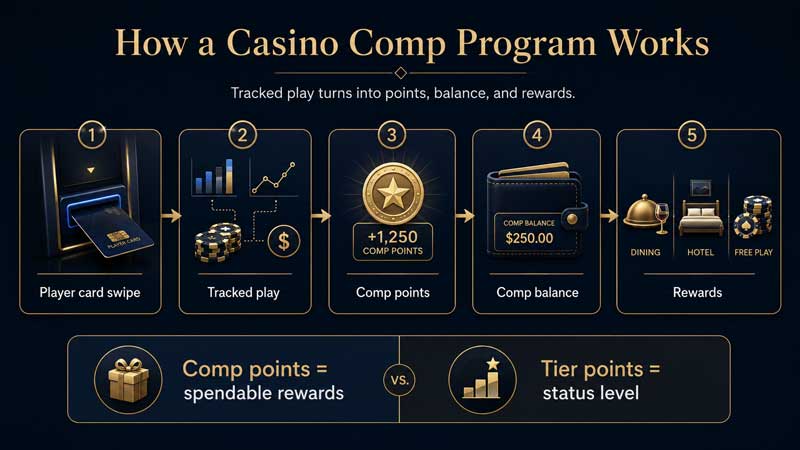
You spend comp points. You don’t spend tier points. Redeeming your comp balance doesn’t knock you down a tier, because the two are tracked independently. Knowing this is the difference between feeling cheated and actually using the program the way it’s built to be used.
How comps are actually calculated: theoretical loss and ADT
Casinos base comps on your theoretical loss also called ADT (average daily theoretical), or just “theo” – not on whether you actually won or lost. Theo is your total wagered multiplied by the game’s house edge, and a percentage of that figure is returned to you as comps.
A quick example. Bet $1,000 over a session on a game with a 1.5% house edge, and your theo is roughly $15. Your comps come from that number, not from the night’s swings.
This is why a player can win big and still earn comps, while another loses fast on a few hands and earns almost nothing – because they barely played. Time and consistency move the needle far more than the result on the screen.
Which player are you in the comp system?
Quick gut-check – you’re probably one of these:
- The slots grinder. Steady play, modest bets. You rack up comp points fast because slots earn quickest.
- The table player. Bigger bets, but your play has to be rated by a pit boss, so carded play matters even more for you.
- The occasional visitor. A few sessions a year. Your balance builds slowly and is the most at risk of expiring.
- The high roller. Tracked closely, often with a personal host, and comped well beyond what points alone would give.
The common thread runs through all four: it only counts if the play is on the card. Uncarded play is invisible to the system – and invisible play earns nothing.
What the data behind a comp program actually sees?
A modern comp program doesn’t just count wagers – it reads patterns. Tracked play captures bet size, session length, frequency, deposit behavior and game choice, and that data is detailed enough that researchers have used it to model player behavior with real accuracy.
A 2022 study by Auer and Griffiths showed that player-tracking data alone can predict player behavior patterns with striking precision. The point for operators isn’t surveillance for its own sake – it’s that the same data feeding comps also reveals who’s valuable, who’s drifting, and who’s worth winning back. Separate research on casino loyalty program design found that well-run programs measurably strengthen the player–casino relationship.
In other words: comps are the visible reward, but the data underneath is the actual asset.
The player card: where every comp program begins
Strip away the software, the tiers and the perks, and a comp program comes down to one object – the card in the player’s hand. No card, no swipe. No swipe, no tracked play. No tracked play, no comps. The whole chain starts there.
That’s why the physical card isn’t a throwaway detail. It’s the entry point of the entire system, and it’s the one piece the player actually touches.
A flimsy, generic card sets a cheap tone. A well-made one with reliable tracking tech reads instantly, lasts longer, and signals that the program is worth taking seriously.
At Cards Print, that’s the whole job. We produce casino premium printed cards and basic player cards built for daily floor use – durable, cleanly personalized, and ready for the RFID, NFC or MIFARE technology your system runs on.
Planning or refreshing a comp program? Request a quote or order samples and check the card quality in hand before you commit.
Running a comp program: setup and the mistakes that break it
A comp program works when three things line up: easy enrollment, reliable play tracking, and rewards players actually want. Break any one of them and the program leaks value. And the most common failure isn’t the reward structure — it’s play that never gets carded in the first place.
The mistakes that quietly drain a program:
- Low enrollment. Cards offered as an afterthought instead of at first contact.
- Unrated play. Table action no one logs, so the player earns nothing and feels ignored.
- Card friction. Slow reads, worn cards, broken chips — every failed swipe is lost data.
- Opaque rules. When players can’t tell comp points from tier points, they stop trusting the program.
Fix the card and the front-line process first; the clever analytics come later. You can’t stop guessing and start tracking if half the floor’s play never makes it into the system.
Online vs land-based comp programs: where the card still matters?
Online and land-based comp programs run on the same logic but different plumbing. Online, play is tied to a login, so tracking is automatic and no card is needed. On a physical floor, the player card is the login – it’s the thing that turns an anonymous session into a recognized player.
Here’s the part worth flagging: as casinos move toward cashless play and account-based wallets, the card doesn’t disappear. It often becomes the access key and the identity layer at the same time. The form changes; the role doesn’t.
FAQ about casino comp program
What is a casino comp program in simple terms?
A casino comp program is a rewards system that gives players free perks — meals, free play, hotel rooms and more — based on how much and how long they play. The play is tracked, usually through a player card, and converted into rewards.
How are comp points different from a comp balance?
Comp points are what you earn per wager. Your comp balance is the running total of points you’ve accumulated and not yet redeemed. You earn points, they add to your balance, and you spend from the balance.
Do comps depend on whether I win or lose?
No. Comps are based on theoretical loss (ADT) — your total wagered times the house edge — not your actual results. You can win on the night and still earn comps, or lose quickly and earn almost none because you barely played.
Do casino comp points expire?
Often, yes. Many programs reduce or wipe your comp balance after a period of inactivity, commonly 90 days to a year. Placing a qualifying wager usually resets the clock.
Why does the player card matter so much for comps?
Because in a land-based casino, a comp program only counts play that’s tracked, and the card is what links your session to your account. No swipe means invisible play — and invisible play earns nothing.
Conclusion: a comp program is only as good as its data
A casino comp program isn’t a pile of free gifts. It’s a system that turns tracked play into points, a balance, and reasons to come back, and every bit of it depends on data that’s clean, complete and tied to the right player. That data has exactly one starting point: the swipe.
Get the card right and the rest of the program has something solid to stand on. Get it wrong and you’re guessing.
Building or upgrading a comp program?
Start where it actually starts.
Talk to Cards Print about casino cards and request your quote today.