
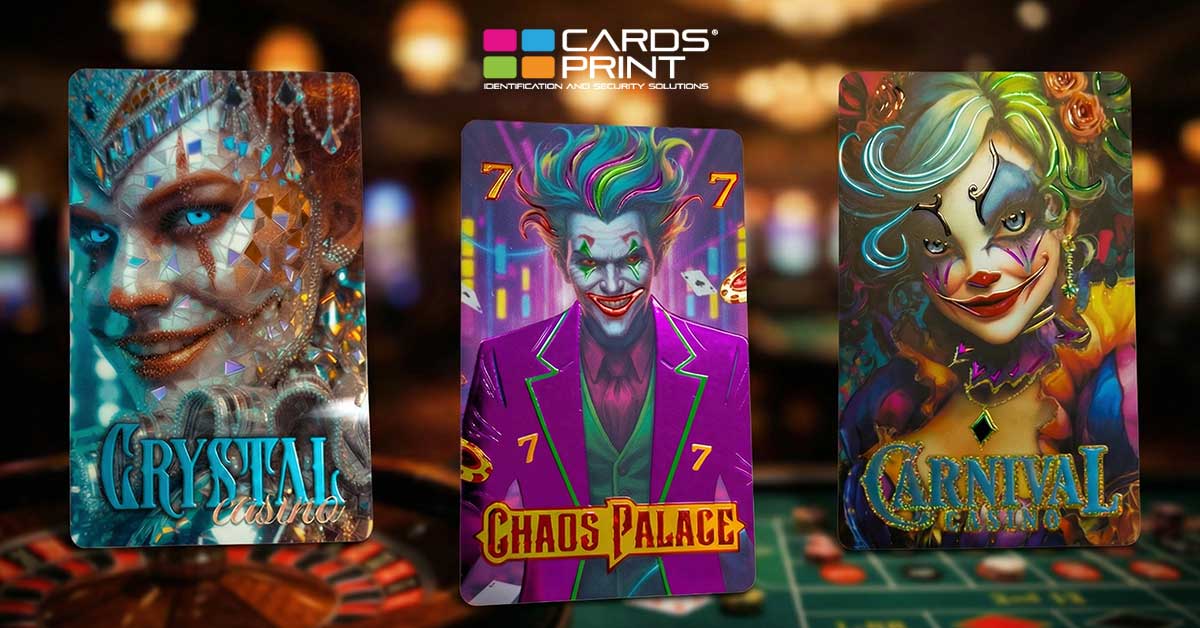
Turn casino cards design into a strategic asset. Elevate prestige, improve performance, and ensure flawless daily use.
At the player desk, the moment is brief-but decisive. A card slides across the counter, and within two seconds the player knows whether it feels like access to something exclusive… or just another plastic badge.
Weight, color, finish, and layout all speak before a single word does. Your casino cards design either reinforces status and confidence, or quietly pulls the entire loyalty program down a tier.
This guide shows you how well designed cards project prestige without sacrificing performance. You’ll learn how to combine color psychology, premium finishes, and clean layouts that look expensive under real casino lighting – and still work flawlessly with RFID, magnetic stripes, barcodes, and variable data systems.
Casino cards design works when it does three jobs at once:
- Signals tier and prestige instantly through color and finish.
- Stays readable under real casino lighting and daily handling.
- Supports your technology and personalization flawlessly—RFID, magnetic stripes, chips, barcodes, and variable data.
What casino cards design actually includes – not just looks!
Casino cards design is not about stripping visuals down to the bare minimum.
Premium printed casino cards can be rich, layered, and visually complex, as long as every element serves a purpose. In real casino environments, the card is a frontline operational asset. It moves constantly between players, staff, machines, and scanners, which means design decisions directly influence desk speed, replacement cycles, and how credible your loyalty program feels to high-value guests.
The strongest casino cards design comes from orchestration, not decoration.
Color systems define tiers, finishes create tactile prestige, security elements protect value, and layout keeps names, numbers, and codes readable under glare and motion.
Beyond aesthetics, well-executed casino cards design delivers measurable operational and branding advantages. You can see the full range of casino cards benefits when design, durability, and technology work together
Color psychology that reads as VIP
Color is usually the first signal a player processes, before weight, finish, or typography.
In casino cards design, palettes do far more than decorate: they communicate tier, exclusivity, and operational seriousness in a fraction of a second.
The goal is not to follow fashion, but to build combinations that read as intentional, stable, and high-value under real casino lighting.
The prestige palette – why it works?
Certain base colors consistently trigger premium associations across luxury industries and casino cards are no exception.
- Deep black conveys authority and discretion.
- Navy suggests reliability and high status without shouting.
- Emerald green connects to wealth and heritage
- Burgundy brings warmth and exclusivity.
These tones create visual depth and give metallic or gloss accents something to “sit on,” rather than float awkwardly on the surface.
Accents matter just as much as the base.
Most high-end programs rely on a single dominant metallic—gold or silver—to signal tier and refinement.
- Gold leans toward warmth, VIP hospitality, and traditional prestige.
- Silver reads cleaner and more technical, often aligning well with modern, data-driven brands.
The fastest way to kill premium
Even expensive production can look cheap if color strategy goes wrong.
- Too many bright or competing tones dilute hierarchy and make tiers harder to recognize at a glance.
- Low-contrast typography, light text on reflective backgrounds, thin strokes on metallic layers, slows staff and frustrates players.
Strong casino cards design treats color as a system, not a collage. Each shade earns its place, supports readability, and reinforces status instead of fighting for attention.
Finishes that make casino cards design feel expensive
In casino cards design, finishes are where visual strategy becomes physical reality. They control how the card reflects light, how it feels in the hand, and how long that first “premium” impression lasts after months of daily use. Smart finish choices don’t just decorate—they reinforce tier systems, protect against counterfeiting, and help a card stand out at the exact moment a player receives it.
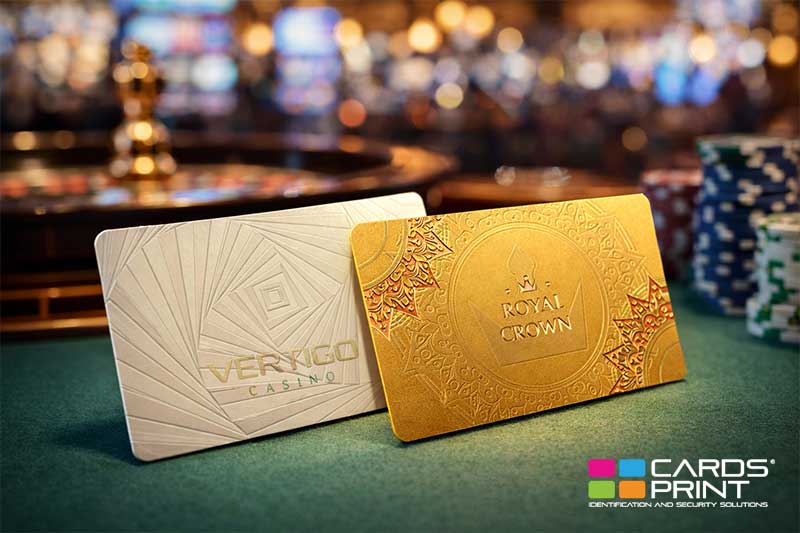
Different effects communicate different kinds of value, and the strongest programs select them deliberately rather than stacking them at random.
Metallic foils immediately read as luxury. Gold, silver, or colored foils catch light at the desk, highlight logos or tier names, and draw the eye without overwhelming the layout.
Spot UV and crystal-style coatings add contrast and dimensionality. By isolating gloss to specific elements—logos, patterns, or tier icons—you create a tactile experience that players literally feel when they run a finger across the surface.
Glitter and pearl layers make a bolder statement. Used selectively, they can elevate VIP tiers or limited editions.
When restraint outperforms excess
High-end casino cards don’t rely on volume—they rely on precision. A matte base paired with a single, sharply placed foil element and well-engineered typography frequently outperforms designs that try to showcase every available effect at once. The contrast between soft-touch surfaces and one reflective accent feels intentional, controlled, and expensive.
For operators evaluating production options, this is where design strategy meets manufacturing expertise. Exploring advanced finishes, protective layers, and card effects helps translate creative concepts into cards that look exceptional—and withstand real-world casino use.
Layout and readability
A card can look spectacular in a mockup and still struggle on the floor.
In real casino environments, speed and clarity matter just as much as aesthetics.
Players hand cards across counters, staff scan them mid-motion, and lighting conditions shift from warm desk lamps to reflective gaming floors. Strong casino cards design anticipates these realities and builds layouts that remain clear under pressure.
Design for real casino conditions
Casino interiors introduce challenges most retail cards never face. Warm ambient lighting can soften contrast, glossy surfaces can create glare, and constant movement means staff rarely view a card straight on for long. Designs that rely on subtle tonal differences, ultra-thin lettering, or low-contrast overlays often collapse in these conditions.
Effective layouts account for reflection angles, preserve strong contrast between text and background, and place critical elements away from heavily reflective zones. Testing readability on finished samples, not just screens, is where premium concepts prove themselves operationally sound.
That’s why choosing a partner who truly understands casino operations matters.
Cards Print has earned the trust of casinos worldwide by consistently combining design excellence, brand positioning, and operational performance into one seamless solution.
Our team doesn’t treat cards as simple pieces of plastic – we see them as extensions of a casino’s identity, symbols of prestige, and frontline tools that must perform flawlessly day after day.
Casino Cards Design as a Physical Expression of Your Brand
Casino cards design plays a direct role in how prestigious a casino brand feels long before a guest reaches the gaming floor.
When materials, color systems, and graphic language align with the casino’s broader identity, the experience feels cohesive and deliberate, not improvised. A high-value guest may never analyze those details consciously, but they register consistency instantly – and consistency is what separates premium destinations from interchangeable venues.
Strong casino cards design therefore doesn’t just support branding; it cements it, turning everyday transactions into repeated brand impressions that reinforce authority, exclusivity, and long-term loyalty.
Design must respect the technology inside the card
As cashless systems become standard across modern casinos, casino cashless cards demand designs that support fast authentication, reliable scanning, and secure daily use.
Even the most striking casino cards design fails if it disrupts scanning, slows staff, or creates errors at machines. For operators, technology is non-negotiable – RFID, NFC, MIFARE, magnetic stripes, chips, barcodes, and variable data systems must work instantly, every time. That’s why production-aware design is not a technical afterthought; it’s a core part of the creative process.
High-performing programs treat technology and visuals as one system. Materials, inks, finishes, and layouts are selected to protect signal strength, preserve readability, and ensure durability across thousands of daily interactions.
Each technology brings physical and visual requirements that shape the layout.
- RFID and NFC demand protected zones that shouldn’t be disrupted by heavy metallic layers.
- Magnetic stripes and chips require precise placement and clean surroundings for smooth swipes and reads.
- Barcodes and QR codes depend on contrast, quiet backgrounds, and abrasion-resistant finishes to stay scannable over time.
- Variable data—names, numbers, tier labels—deserves the same discipline. Burying these elements inside dense patterns, reflective foils, or busy gradients may look dramatic in concept, but it slows verification and increases reprint rates in real life. Smart casino cards design reserves calm, high-contrast areas where personalization remains clear from every angle.
That’s exactly why who produces your cards matters so much.
Casino cards design demands far more than visual taste – it requires a team that understands technology, manufacturing processes, and real casino operating conditions.
Cards Print brings together professional designers and technical specialists with years of experience in casino card production, guiding each project from the first concept to final delivery. From visual direction, color systems, and finish selection to layout engineering, RFID and barcode protection zones, and strict quality control in manufacturing – every step is built to ensure your cards look exceptional and perform flawlessly. The result is a card program that strengthens brand perception, lasts longer, operates more reliably, and leaves a strong impression every time a player holds it.
Personalization that makes players keep the card
Personalization turns a casino card from a generic access tool into something players actually value. Names, tiers, and unique identifiers create a sense of ownership, while also powering loyalty systems behind the scenes. In high-end casino cards design, the challenge is to integrate variable data without breaking the visual language of the card or compromising durability.
When done well, personalization strengthens prestige instead of diluting it. The card feels bespoke, intentional, and tied directly to the player’s status, making it less likely to be discarded and more likely to stay in wallets long after the first visit.
In loyalty-driven environments, premium casino rewards cards reinforce status, encourage repeat play, and make tier progression visible and aspirational.
Variable data that stays premium
Premium programs treat names and numbers as design elements, not afterthoughts. Metallic-foil personalization, laser engraving, or high-resolution digital printing can integrate variable data seamlessly into luxury layouts—so every individual card maintains the same visual authority as the master design.
Barcodes and QR codes demand equal attention. These functional zones must remain high-contrast, abrasion-resistant, and free from reflective effects that could interfere with scanning. Protective coatings and carefully planned placement keep them readable over time, even after constant handling.
What Cards Print can produce?
Great casino cards design only matters if it can be manufactured at scale, personalized accurately, and integrated into live casino systems without friction. That’s where execution separates concepts from results. Cards Print focuses on turning design strategy into production-ready cards that feel premium in the hand and perform flawlessly on the floor.
Operators work with us to create premium printed casino cards that combine advanced materials with high-impact finishes—so visual ambition never comes at the cost of durability.
Our personalization workflows handle variable data, tier systems, and individual player identities with precision, while also supporting protective features that help safeguard card value. And with tech-ready options—including RFID, NFC, MIFARE, magnetic stripes, chips, and barcodes—every design integrates smoothly into existing infrastructure from day one.
Tell us your quantities, technology requirements (RFID, magstripe, barcode), and tier structure. We’ll propose a premium design and finish set built specifically for your casino program.
When Premium Design Also Means Protection
Strong casino cards design also plays a critical security role.
Cards built with high-quality materials and layered design elements, such as complex color systems, premium finishes, and precisely engineered details, are far more difficult to replicate.
This added complexity significantly reduces the risk of counterfeiting and misuse within loyalty programs. When sophisticated visual design is combined with durable, production-grade card quality and reliable technology, the card is no longer an easy target – it becomes a secure, controlled asset that protects both the casino and its players.
Frequently Asked Questions About Casino Cards Design
How does casino cards design influence player perception?
Design shapes expectations instantly. Premium colors, finishes, and typography communicate status before a player even uses the card. A well-designed casino loyalty card makes the loyalty program feel organized, exclusive, and worth engaging with—while weak design can quietly reduce perceived value.
Can casino cards design help differentiate VIP tiers visually?
Yes. Strong tier systems rely on distinct visual languages—different base colors, accent metals, textures, or graphic patterns—so staff and players recognize status immediately without reading small text. Clear visual separation also reinforces aspiration between levels.
What role does texture play in premium casino cards design?
Texture adds a subconscious luxury cue. Soft-touch matte coatings, raised UV elements, or embossed areas increase perceived quality and make cards more memorable to hold. These tactile signals often matter as much as visual ones.
Should casino cards design match overall casino interior branding?
Absolutely. The strongest designs echo architectural materials, lighting styles, and brand colors already present on the floor. This consistency makes the card feel like a natural extension of the casino experience rather than a disconnected marketing item.
How future-proof should casino cards design be?
High-performing designs avoid short-lived trends and rely on flexible systems. Modular layouts, adaptable tier zones, and timeless palettes allow casinos to refresh programs later without redesigning everything from scratch.
Does better design reduce replacement rates?
Often, yes. Thoughtful layouts protect high-wear zones, finishes resist scratching, and variable-data areas stay legible longer. That translates into fewer reprints, lower operational costs, and a cleaner brand image over time.
Can casino cards design support marketing campaigns or special editions?
Definitely. Limited editions, seasonal VIP cards, tournament cards, or anniversary designs create excitement and collectability—while staying aligned with the main visual system of the loyalty program.
How early should design teams involve production specialists?
As early as possible. When designers understand materials, finishes, and technology constraints from the start, they create concepts that move to production faster, cost less to revise, and perform better in real-world casino environments.
Casino cards design is never just about how a card looks – it’s about how a brand feels, how smoothly operations run, and how confidently players engage with your loyalty program.
From color psychology and finishes to layout discipline, personalization, and technology integration, every design choice sends a signal. When those signals align, the result is a card that communicates prestige instantly, works flawlessly on the floor, and keeps players coming back.
The strongest casino programs treat their cards as long-term brand assets, not disposable tools.
They invest in visual systems that scale across tiers, survive daily use, integrate seamlessly with RFID and scanning infrastructure, and remain relevant as programs evolve. Done right, casino cards design becomes a competitive advantage, quietly reinforcing trust, status, and consistency at every touchpoint.
Ready to elevate your casino cards design?
Work with a production partner who understands both creative ambition and operational reality.