
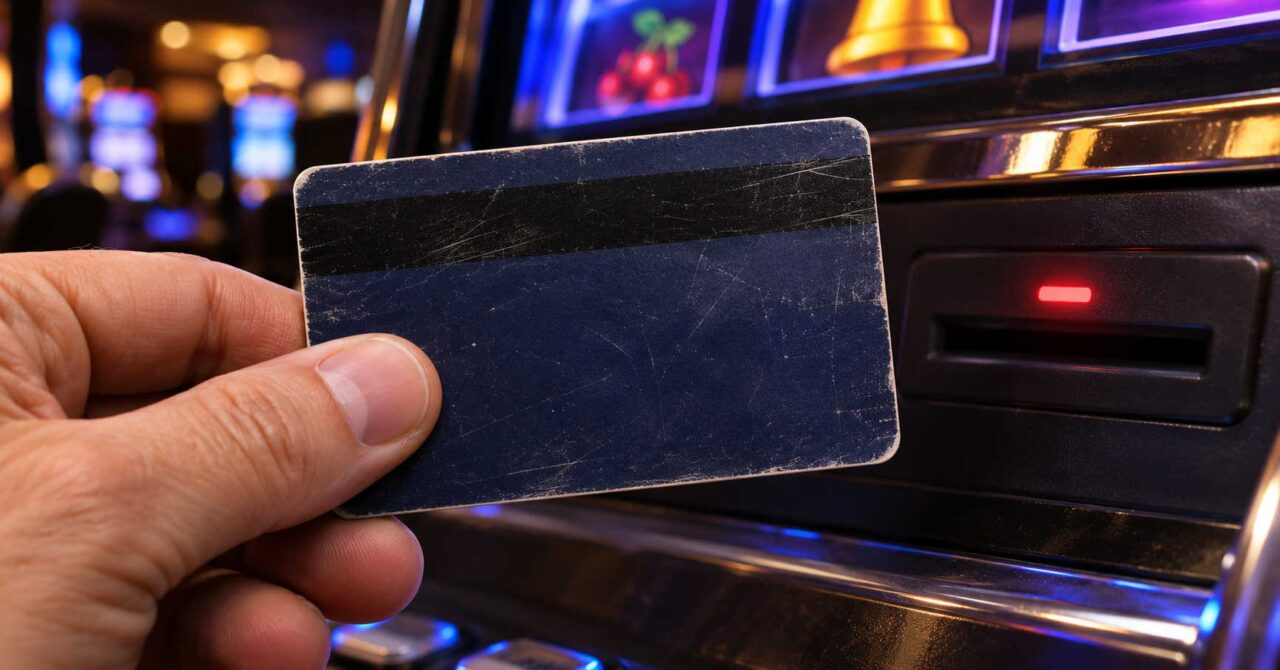
What does a worn-out player card really cost? Lost rated play, wrong comps and stalled tiers. Here’s why card quality matters.
A player sits down at a slot machine and inserts their card. The screen flickers and shows a card error. They try again, shrug, and keep playing without it.
The machine still takes the money. Your player tracking system never hears about it.
If your players club desk hears “my points are missing” more often than it should, keep reading.
Why Player Cards Fail (and Why It’s Rarely the Technology)
When a card stops working, the first reaction is often to blame the technology: magnetic stripes are old, chips are fragile, contactless is unreliable. In practice, most failures come down to how the card was made, not what kind of card it is.
A player card has four parts that can fail, and each one depends on build quality.
The card body. A card that bends, cracks or splits in a wallet stops reading properly, whatever technology it carries. Heat from a car dashboard and long exposure to sunlight make it worse.
The print and surface. Without a proper protective layer, printing fades, scratches and peels. A faded card still reads, but it no longer looks like something a player wants to keep or show.
The magnetic stripe. A magnetic stripe card stores player data in a thin band of magnetic material that a reader picks up as the card is swiped or inserted. Two things decide how long it lasts: coercivity and application. The stripe also has to sit perfectly flat and bonded to the card. An uneven or poorly laminated stripe wears unevenly and starts failing early.
The chip and antenna. Contactless cards such as a MIFARE card don’t rub against a reader, but they have their own weak point: the antenna and chip embedded inside the card. Rigid cards with embedded electronics can crack over time, and that the durability of the chip, antenna and connections largely decides how long a contactless card lasts.
So every technology has a weak spot. Quality decides whether that weak spot ever becomes a problem.
Is It the Card or the Player?
Operators often assume worn cards are the players’ fault. People keep cards next to phones, bend them in back pockets and leave them in hot cars.
The honest answer is both.
Players are hard on cards, and that’s exactly why quality matters.
There’s also a pattern most operators haven’t noticed: the card that wears out first belongs to your best player.
A player who visits once a month inserts their card maybe a dozen times a year. A regular who plays three times a week, moving between machines, may insert it thousands of times. Every insertion, every trip in and out of the wallet and every hour in a back pocket adds wear.
A cheap card can survive an occasional visitor for years. With your most loyal player, it can fail within months. That means card failures don’t hit your database evenly. They cluster in the segment worth the most to you.
Five Signs Your Cards Are Costing You Rated Play
Check these against your own floor and players club desk.
- Replacement requests are rising. If more players are asking for new cards and the reason is “it stopped working,” the problem is the cards, not the players.
- “My points are missing” complaints. Often the points aren’t missing. The play was never recorded because the card failed and the player continued without it.
- Staff re-swiping or entering play manually. Every manual fix costs staff time and depends on the player bothering to ask.
- Visibly worn cards in high tiers. Ask a host to look at the cards your top players carry. Scratches, faded print and peeling edges show you what your mid-tier cards will look like next year.
- Read errors concentrated on certain machines. If your system reports card read errors, look at the pattern. Errors spread across the floor usually point to the cards. Errors concentrated on a few machines usually point to the readers.
If two or more of these sound familiar, your cards are probably costing you more than they cost to make.
The Read-Failure Math
Here’s where a worn-out card becomes a business problem. The numbers below are an illustrative example, not an industry average. Replace them with your own.
Imagine a casino with 5,000 carded slot sessions a day.
- Assume 2% of card insertions fail on the first attempt. That’s 100 failed reads a day.
- Assume half of those players give up and keep playing without the card. That’s 50 untracked sessions a day.
- Over a year, that’s 18,250 sessions that never reach a player account.
- If an average session carries $30 in theoretical win, that’s $547,500 a year in play that your system never sees.
To be clear: the casino still earns that revenue. The money goes through the machine either way. What’s lost is everything that depends on knowing who played:
- Comps are calculated on less play than the player actually gave you.
- Tier progress stalls, so players who earned the next level don’t reach it.
- Offers and marketing target a version of the player that’s smaller than the real one.
- Trust takes a hit. A player whose card fails and whose points then look low starts to wonder whether your system works. That’s how the myth that player cards are “rigged” stays alive.
The formula is simple: daily carded sessions × read-failure rate × share who continue uncarded × average theoretical per session × 365. Most operators have the first and last numbers already. The middle two are the ones nobody measures.
What Quality Actually Means in a Player Card
“Quality card” is easy to say and hard to check. Here’s what it means in practice, whatever technology you use.
- A card body built for daily handling. The material and construction should hold up to bending, heat and constant trips in and out of a wallet.
- A protective surface. A protective coating over the print keeps colors and branding intact, so the card still looks like your brand after a year.
- A properly applied stripe. HiCo encoding, a stripe that sits flat and is fully bonded, and consistent encoding across the whole order.
- A properly embedded chip and antenna. For contactless cards, the electronics must sit securely inside the card body so normal flexing doesn’t break the connection.
- Quality control before delivery. Every batch should be checked for print, stripe and chip performance before it reaches your desk, not after players start complaining.

Now the honest part. A better card won’t:
- fix dirty or faulty readers in your slot machines,
- correct a poorly configured casino management system,
- make a weak comp program worth using,
- replace staff who never mention the players club.
What a better card does is remove one of the most common, and least visible, reasons play goes untracked.
Where Cards Print Comes In
This is the part of the problem we deal with every day. At Cards Print, we produce player cards across technologies, from HiCo and LoCo magnetic stripe cards to MIFARE Classic, MIFARE DESFire, MIFARE Ultralight, MIFARE Plus and NFC, because the right technology is the one your system already uses.
What doesn’t change is the standard. Whether a card carries a stripe or a chip, it has to read reliably on day one and still look like your brand after months in a player’s wallet. Our premium printed casino cards are built around that idea: durable construction, protected print and finishes that hold up to real use.
If you’re comparing suppliers, the useful question isn’t “how much per card?” It’s “how much per year of reliable use?”
Magnetic Stripe or MIFARE? Choose by Your System, Not by Hype
The smart card vs magnetic stripe card debate usually gets framed as old versus new. For a casino, that’s the wrong question. The right technology is the one that works with the readers and casino management system you already have, made well enough to last.
| Magnetic stripe card | MIFARE (contactless) card | |
|---|---|---|
| How it reads | Inserted or swiped through a reader | Tapped or held near a reader |
| Where it’s strong | Compatible with a very large installed base of slot readers; simple and proven | No physical contact with the reader; supports more data and stronger security options |
| Its weak point | The stripe surface and its bond to the card | The embedded chip and antenna |
| What quality must guarantee | HiCo encoding, a flat and fully bonded stripe, a durable card body | A securely embedded chip, an antenna that survives flexing, a durable card body |
Within MIFARE, the main difference operators need to know is security. MIFARE Classic is widely used and cost-effective. MIFARE DESFire (EV1, EV2 and later versions) uses stronger encryption and is the usual choice when security is a priority, such as for cards linked to cashless play or stored value.
If you’re happy with your current system, there’s no reason to switch technology just to fix wear. Better cards in the technology you already use usually solve the problem faster and cheaper. If you’re planning a system change anyway, that’s the moment to decide on technology, and quality still matters just as much.
How to Get More Life Out of Every Card
A practical checklist:
- Clean and check your readers. A dirty reader damages cards and causes errors that look like card failures. Make reader maintenance part of the floor routine.
- Make HiCo your standard. If you use magnetic stripe cards, there’s no good reason for a long-term player card to be LoCo.
- Issue a new card when a player moves up a tier. It refreshes worn cards in your most active segment and turns a promotion into a physical moment. A well-structured tier ladder works best when players can see and feel where they stand.
- Replace worn cards before they fail. When a host or desk agent sees a damaged card, swap it on the spot. With ID card printers for player names, the player leaves with a new personalized card instead of a promise.
- Test a sample before a large order. Carry a few sample cards in a wallet for a few weeks and run them through your own readers before you order thousands.
The most common mistakes
- Choosing on price per card alone. A cheaper card that fails twice as fast costs more per year of use, before you count the untracked play.
- Using LoCo stripes for long-term cards. They’re designed for short-term use.
- Skipping the protective surface. The card still reads, but it stops looking like your brand.
- Never checking cards in circulation. Cards issued years ago may be failing quietly in your best players’ wallets.
- Blaming the technology. Switching technology without improving quality just moves the problem somewhere else.
The Six-Month Test
Picture two casinos with the same loyalty program, the same benefits and the same card technology.
The first chose the cheapest card it could find. After six months in a regular’s wallet, the edges are white, the logo has faded, and the card needs two or three tries before the machine accepts it. On a busy night, the player stops trying.
The second chose a card built for daily use. After the same six months, it looks almost new, reads on the first insertion, and the player still takes it out at the bar without thinking twice.
Both casinos paid for a card. Only one of them is still collecting the data.
The card is also often the most handled piece of your brand. Players touch it more often than your website, your mailers or your signage. When it looks worn, your brand looks worn, and players who feel proud of their card are the ones who carry it. We’ve written more about that in why players leave their cards behind and why personalized player cards build stronger bonds with your brand.
Conclusion
The play happens whether the card reads or not. The only question is whether you know it happened.
A worn-out card is easy to ignore because nothing visibly breaks. The machine keeps running, the money keeps coming in, and the gap only shows up in data nobody connects to the card.
So take a card from one of your regulars and look at it. If it wouldn’t pass the six-month test, talk to us .
Send us a card that’s been in use, and we’ll tell you honestly what’s wearing out and what would make it last.
Frequently Asked Questions
What causes a worn-out player card?
A worn-out player card is usually the result of daily handling: bending in a wallet or back pocket, friction in readers, heat from car dashboards and contact with magnets or phones. How quickly that wear turns into a failure depends on build quality, including the card body material, the protective surface over the print, and how well the magnetic stripe or chip is applied.
How can a casino tell if a worn-out card is the problem, not the reader?
Look at where read errors happen. If errors are spread across many machines and follow certain players, the cards are the likely cause. If they cluster on a few machines regardless of who plays, the readers need cleaning or service. Testing a new card and an old card in the same reader is a quick way to confirm.
How often should worn-out player cards be replaced?
There is no fixed schedule, because wear depends on how often a player uses the card. A practical approach is to replace a card as soon as staff notice visible damage or repeated read errors, and to issue a new card whenever a player moves up a tier, which naturally refreshes cards in your most active segment.
Do worn-out cards affect magnetic stripe and MIFARE cards the same way?
Both can wear out, but in different places. A magnetic stripe card can fail when the stripe is scratched, unevenly bonded or accidentally erased. A MIFARE card can fail when its embedded chip or antenna is damaged by repeated bending. In both cases, materials and construction decide how long the card lasts, not the technology alone.
Can a worn-out player card cost a player their points?
The points themselves aren’t lost, but the play may never be recorded. If a worn-out card fails at the machine and the player keeps playing without it, that session doesn’t count toward their points, comps or tier progress. Replacing damaged cards quickly is the simplest way to prevent it.
A worn-out player card never makes a scene. The machine keeps running, the money keeps coming in, and nobody files a report. The cost shows up somewhere else: comps that don’t match real play, players stuck below the tier they earned, and a database that slowly gets smaller than your floor.
And it starts with your best players, because they use their cards the most.
The fix isn’t switching technology. It’s choosing a card that’s built to last in the technology you already use: a durable body, protected print, a properly applied HiCo stripe or a securely embedded chip, and quality control before the cards ever reach your desk.
The play happens whether the card reads or not. The only question is whether you know it happened.