

An uncarded player can visit your casino every week and still remain a stranger to your loyalty program. Why does their card stay in a drawer—and what would make it worth carrying? The answer starts before they reach your floor.
Your floor is busy. The machines are running, the bar is full, and the parking lot says it’s a good night. Then the player tracking report comes in, and it describes a much quieter casino.
The missing players are real. They spend money, they come back, and some of them come back every week. As far as your system is concerned, though, they don’t exist.
If you’ve ever looked at a full floor next to a half-empty database and wondered where the gap comes from, keep reading.
What Is Uncarded Play (and How Big Is the Gap?)
Uncarded play is any gaming activity that happens without a player card inserted or presented, so it never reaches the casino’s player tracking system.
The casino still records the money that goes through the machine, but it can’t connect that play to a person. That means no rating, no comps, no player profile, and no way to invite that player back.
Here’s what that costs you. You can’t see who your best uncarded players are, so you can’t reward them. You can’t send them an offer, so you can’t bring them back on a slow Tuesday. And because they’ve never received anything personal from you, there’s nothing stopping them from playing at the casino across the street next time.
An uncarded player is loyal to convenience, not to you.
Is It a Marketing Problem or a Card Problem?
Most advice on uncarded play treats it as a persuasion problem. Explain the benefits better. Train the staff. Offer a sign-up bonus.
That’s half the answer.
Marketing explains why a player should use the card. The card itself decides whether the player has it in hand when they sit down at a machine.
Picture a regular player who knows exactly what the players club offers and fully intends to use it. The card is in yesterday’s jacket. Tonight’s play goes untracked anyway.
So the honest answer is: both. You need a reason to play carded, and you need a card the player actually carries.
Why Players Stay Uncarded: Five Profiles You’ll Recognize
Most uncarded players fit one of five profiles. Read through them and think about your own floor.
- The Forgetter. The card is in another wallet, in the car, or at home, and they don’t want to queue at the booth for a replacement. What it means for you: this is a memory problem and a card problem at the same time. Cards that live in the front of the wallet get remembered. Cards that live behind old receipts don’t.
- The “Just 20 Minutes” Player. They’re only playing briefly, so they assume it isn’t worth it. Many believe comps are only for high rollers. What it means for you: they don’t see any small, immediate value. If nothing changes after their first carded session, they have no reason to repeat it.
- The Skeptic. They believe inserting a card makes the machine pay less. What it means for you: the myth survives where nobody answers it. Your floor staff need one calm, confident sentence ready.
- The Anonymous Player. They simply don’t want to be tracked. What it means for you: respect it. No card design, offer or script will change this player’s mind, and pushing too hard only damages the visit.
- The Disappointed Member. They signed up, nothing visible happened, and the card ended up in a drawer. What it means for you: when a card looks the same at every level, it gives the player no sign of progress, and no reason to keep going.
A quick check: if most of your uncarded players fall into profiles 1, 2 and 5, part of your fix is physical. It’s about the card, not just the message.
The Wallet Test: What Your Card Is Telling Players
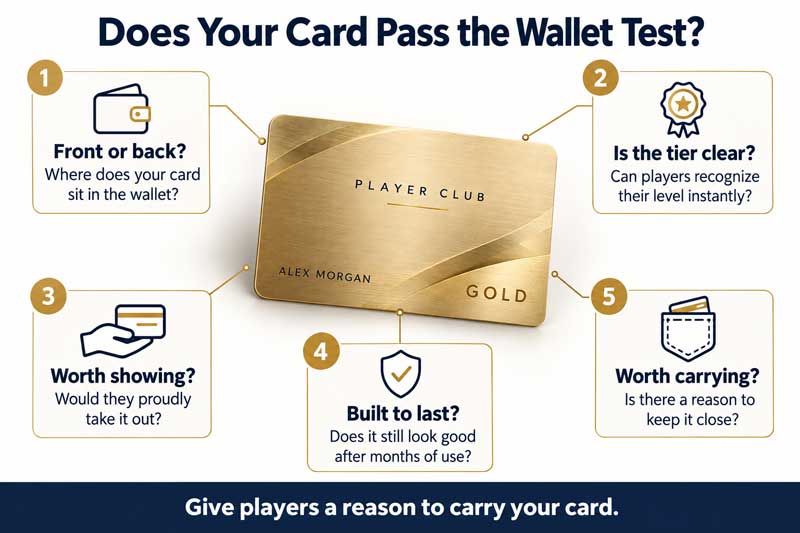
Take your own player card and put it on the table next to a bank card, a gym membership card and a coffee shop loyalty card. Then answer five questions honestly.
- Front or back? Would a player keep your card in the front slot of their wallet, next to the cards they use every day, or at the back with expired coupons?
- Can they see their tier? Can a player tell their level at a glance, or does every tier look like the same card with a different word printed on it?
- Would they show it? Is this something a player would put on the table in front of friends, or something they’d slide into the machine quickly so nobody notices?
- How does it age? After six months in a wallet, is the card still presentable, or is it scratched, faded and peeling? A card that doesn’t read cleanly at the machine is one more reason to stop inserting it.
- Is there a reason to carry it? Does the player have any reason to keep it on them when they aren’t planning to play?
If your card gets two or more “no” answers, it’s part of your uncarded play problem.
The principle behind the test is simple: people carry what feels personal or signals status, and they forget what feels like paperwork.
What a Better Card Can (and Can’t) Fix
There’s solid behavioral research behind the idea that ownership changes how people treat an object. In a classic series of experiments, Kahneman, Knetsch and Thaler showed that people who were given an ordinary coffee mug asked roughly twice as much to give it up as other people were willing to pay for it. Simply owning something made it more valuable to them. Researchers call this the endowment effect.
In casino terms: a card with the player’s name on it, in the color of the tier they earned, is an object they own. A generic card with a barcode is an object the casino lent them. People hold on to the first and lose track of the second.
Now the honest part. A better card won’t:
- convert a player who wants to stay anonymous,
- fix a comp program that doesn’t give players anything worth having,
- replace staff who never invite players to join,
- make a weak offer look strong.
What a better card does is remove friction.
It doesn’t create motivation; it makes sure the motivation you’ve already built isn’t lost because the card stayed at home.
Where the Card Itself Comes In
If your card failed the Wallet Test, this is where it’s worth looking. It’s also the part of the problem we work on every day at Cards Print.
Three things make the biggest difference to whether a card gets carried:
- Material and durability. A card that still looks good after months in a wallet is a card players don’t mind showing. Premium printed casino cards are built to hold their look and read reliably over time.
- Tiers that look different, not just read different. When each level has its own finish, color or special effect, moving up the ladder is something the player can see and feel in their hand.
- The player’s name on the card. Personalization turns “the casino’s card” into “my card.” That’s the endowment effect working in your favor.
None of this replaces a good loyalty program. It makes sure the program you already have travels with the player instead of staying in a drawer.
How to Move Players From Uncarded to Carded?
A practical sequence most casinos can start this month:
- Remove the queue. If getting a card means waiting at a booth, many players won’t bother, especially Forgetters who just need a replacement. Issuing cards on the spot with ID card printers for player names means the player leaves their first visit with a finished, personalized card in hand.
- Make the first reward immediate. The “Just 20 Minutes” player needs to see value in the same visit, not in a monthly statement. A small, instant benefit after the first carded session proves the card works.
- Give floor staff one sentence. For the Skeptic: “The card has no connection to how the machine pays. It only records your play so we can reward it.” Short, calm and repeatable.
- Bring the offer to the machine. Players insert cards when there’s something to gain in that moment.
- Make progress physical. When a player reaches a new tier, hand them a new card. A well-structured tier ladder only motivates if the player can see where they stand.
The most common mistakes
- One generic card for every tier. If Gold looks like Basic, nobody aims for Gold.
- Thin cards that wear out fast. A scratched card is easy to forget and awkward to show.
- Selling benefits without a reason to carry the card. Players can love your comp program and still leave the card at home.
- Treating all uncarded players as one group. The Skeptic needs an answer, the Forgetter needs a better card, and the Anonymous player needs to be left alone.
- A slow replacement process. For a regular, a lost card and a long wait can mean weeks of untracked play. Make reissuing fast and transfer their points and tier immediately. If your comp program depends on tracked play, so does the replacement process.
The Status Card: Why the Card Players Show Off Is the One They Carry
Ask any host and they’ll tell you the same thing: high-tier players almost never play uncarded. Part of that is value, since they have more to earn. Part of it is identity. At the top of the ladder, the card stops being a tool and becomes something the player is proud of.
Imagine two casinos with identical Gold tiers and identical benefits.
At the first, the Gold card is the standard card with the word “Gold” printed in the corner. It goes into the wallet with everything else.
At the second, the Gold card has its own finish, carries the player’s name, and is handed over in a holder at a short moment at the desk. The player takes it out at the bar to show a friend. It lives in the front of the wallet.
Which player is more likely to forget their card next Friday?
This is why the way a card is presented matters as much as the card itself.
A holder for VIP player cards gives the card a home and signals that it’s worth keeping. We’ve written more about why personalized player cards build stronger bonds with your brand, and about why consistency across every tier is what makes a casino feel premium.
The lesson for the uncarded problem: you don’t only want to move players up the ladder. You want players at every level to feel a little of what your top tier feels when they hold the card.
Frequently Asked Questions
What is the difference between uncarded, carded and rated play?
Uncarded play is any session where no player card is inserted or presented, so the play can’t be linked to a person. Carded play means a card was used. Rated play is what the system actually recorded for that player: time, amount wagered and average bet. A session can be carded and still poorly rated, for example if the card was pulled out halfway through or a table rating was never entered.
Does uncarded play happen at table games too?
Yes. At tables, play is rated by floor or pit staff when the player presents a card. If no card is presented, the session stays uncarded. Some table players refuse a card on purpose, which is why the pit is often where uncarded play is hardest to reduce.
How can a casino measure how much of its play is uncarded?
Compare total coin-in from slot accounting with rated coin-in from the player tracking system over the same period. The difference is your uncarded share. Tracking it by area, time of day and machine type shows where players most often skip the card, which tells you where to focus staff and promotions first.
Can a mobile app reduce uncarded play, or is a physical card still needed?
An app helps with offers and account information, but it rarely solves uncarded play on its own. On the floor, a physical card works without a phone, signal or battery, works at every machine, and is something the player can hold and show. For most land-based casinos, the app and the card work best together.
Can a lost player card turn a regular into an uncarded player?
Yes, and it happens more often than operators think. If replacing a card means queuing at the booth, a regular may simply keep playing uncarded for weeks. Reissuing the card on the spot and carrying over points and tier status immediately keeps that player in the system.
The uncarded player isn’t lost. Most of the time, they just haven’t been given a good enough reason to introduce themselves.
Marketing gives players a reason to play carded. The card gives them a reason to carry it. You need both, and the second one is usually the one nobody checks.
So run the Wallet Test on your own card this week. If it fails, contact us.
We’ll look at your current card and tier ladder with you and tell you honestly what would make a difference, and what wouldn’t.